


A fare that looks straightforward can conceal costs beyond the passenger’s ride. The hidden costs of ride-sharing for business include unpaid deadhead mileage, which raises the effective cost of each paid trip, and platform commissions, which can take 25 to 40% of an operator’s fare. The gap between the quoted fare and the true operating cost matters when businesses assess ride budgets or operators compare booking channels.
It’s easy to focus on the amount charged for a completed journey, but less visible mileage and fees can change the calculation. Understanding these costs helps explain why similar trips may have different economics, even before other operating expenses are considered.
This article explains how deadhead mileage affects per-trip costs, how fare pricing shapes the final calculation, and how platform commissions compare with direct bookings. You’ll see where costs arise and why the distinction matters when evaluating ride-sharing for business travel or operations.
Key Takeaways
- Assess a trip by its full billed amount, not just the initial fare; add-ons and pricing conditions can change the total.
- Compare rideshare, taxi, rental, and mileage-reimbursement options using the same journey and business needs.
- Separate account-level charges from per-trip charges to understand how billing affects travel budgets.
- Recognize how tips, tolls, surge pricing, and cancellations can add to a journey’s cost.
- Factor in taxes, airport fees, and local surcharges when estimating what a business trip will ultimately cost.
Platform commissions versus direct bookings
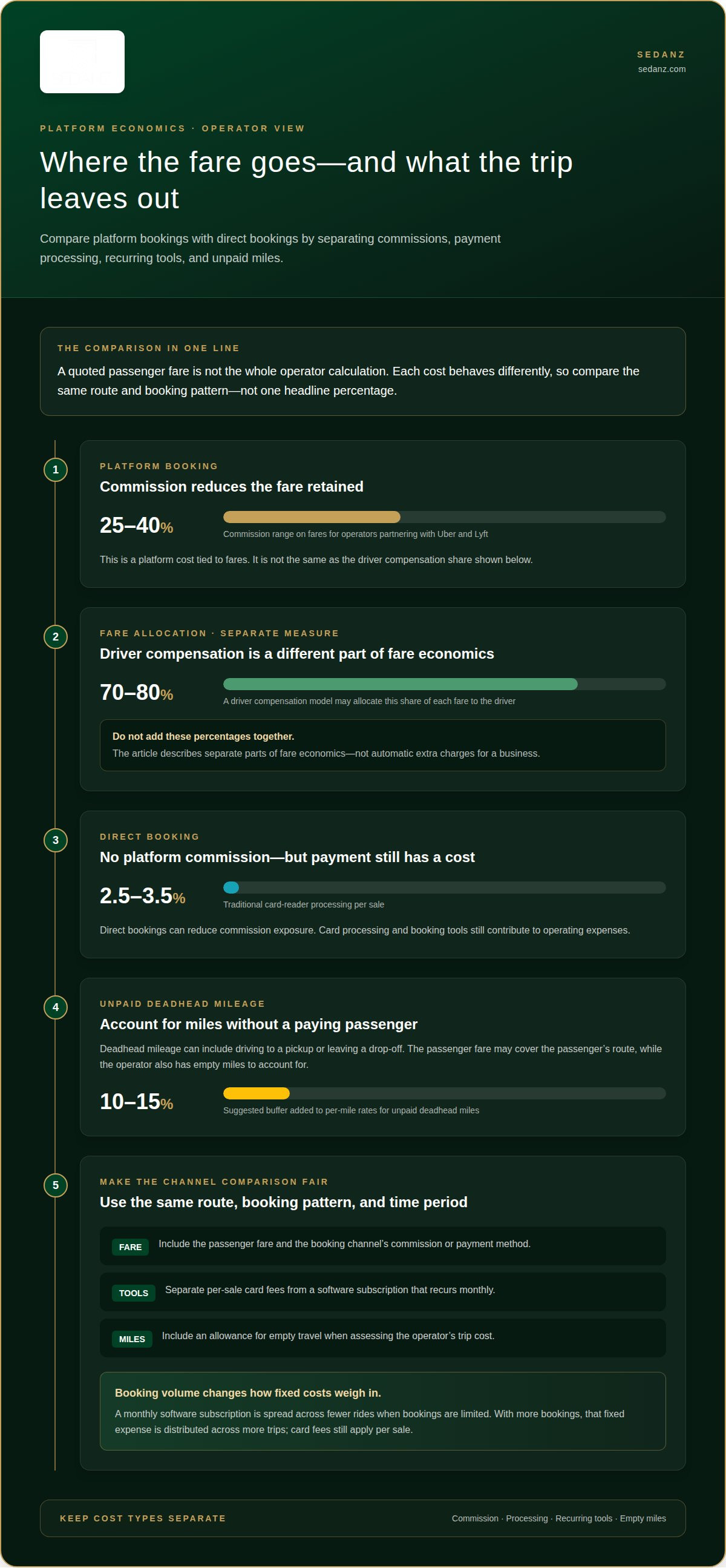
Ride platforms can connect operators with customers, but commissions reduce the fare retained. Operators partnering with Uber and Lyft may surrender 25 to 40% of each fare as platform commissions. A driver compensation model may allocate 70 to 80% of each fare to the driver. These percentages describe separate parts of fare economics, not charges a business should automatically add together. The hidden costs of ride-sharing for business travel can be difficult to see if a company considers only the passenger’s quoted fare.
Direct bookings avoid platform commission, but still involve costs. Traditional card-reader payment processing is listed at 2.5% to 3.5% per sale. One charge follows each card sale; the other recurs monthly. A direct-booking channel may reduce commission exposure, while payment processing and booking tools still contribute to operating expenses.
Unpaid deadhead mileage also affects the operator’s calculation. It means driving without a paying passenger, such as reaching a pickup or leaving a drop-off. A fare may cover the passenger’s route, while the operator also accounts for those empty miles. Operators are advised to add a 10 to 15% buffer to per-mile rates for unpaid deadhead miles. This is another reason the hidden costs of ride-sharing for business extend beyond the fare displayed for a completed trip.
Separate the main cost types before comparing channels:
- Platform commission: 25 to 40% of fares for operators partnering with Uber and Lyft.
- Card processing: 2.5% to 3.5% per traditional card-reader sale.
- Deadhead mileage: a suggested 10 to 15% buffer in per-mile rates.
Compare the same route and booking pattern. Include the fare, payment method, dispatch expense, and allowance for empty travel. A commission and card fee vary with sales, while an app subscription recurs monthly. Deadhead mileage changes the operator’s cost of completing a trip. Because these categories behave differently, one headline percentage cannot show the full economics of either channel.
Booking volume also changes the weight of fixed and transaction-based expenses. For example, a monthly software subscription is spread across fewer rides when bookings are limited. With more bookings, that fixed expense is distributed across more trips, while card fees still apply per sale. Compare channel costs over the same period and trip mix to see what direct bookings retain and what platform access costs.
How much do business rideshare trips cost compared with taxis, rental cars, and mileage reimbursement?
A useful comparison starts with the same route, travel time, and passenger needs. Treat the result as a location-specific example, not a universal taxi fare. A comparable rideshare journey can have a different total because its fare depends on the trip and pricing conditions at booking.
For rideshare, compare the final trip charge with the value of the journey, not an isolated estimate. Note the pickup and destination, passenger count, and timing. Then distinguish the quoted fare from the amount ultimately charged, including added trip expenses. A short city ride and an airport transfer serve different needs, so their totals are meaningful only when the routes and requirements align.
A taxi comparison works best when the business examines the same origin and destination. In the Raleigh-Durham example, the approximate 14-mile route gives finance teams a concrete reference point. Avoid applying that figure to other cities or trips. A different airport, destination, or journey distance changes the comparison.
Rental cars follow a different cost pattern. The total includes the rental charge and trip-related expenses, such as fuel and parking. Account for how long the vehicle is needed and whether one employee or several people will travel. A rental can support multiple stops, while a single rideshare fare covers a specific journey. Compare the full itinerary, not one ride against one rental line item.
Mileage reimbursement is calculated differently. It connects an employee’s business driving to the company’s reimbursement policy, rather than charging for a dispatched passenger trip. The total depends on the business miles recorded and the applicable policy rate. Separate personal vehicle costs from the employee’s reimbursed amount, then compare that figure with transportation for the same itinerary.
- Rideshare: compare the complete trip charge for the specified route and time.
- Rental car: include rental duration, fuel, parking, and planned stops.
- Mileage reimbursement: use documented business miles and the company’s policy.
For a one-way airport trip, a taxi fare offers a reference point, while a rental’s duration and parking can affect its overall value. For a multi-stop day, compare rental use and reimbursement more closely. Matching the route, schedule, passengers, and itinerary gives each option a fair assessment without treating one city’s fare as a national benchmark.
Do business rideshare accounts charge monthly, per-user, or transaction fees?
Business rideshare billing can involve three distinct fee models: recurring account charges, user-based charges, and trip-based charges. The exact structure depends on the account terms. Identify each charge separately before estimating a travel program’s cost. A completed ride may seem straightforward, while account administration or employee access can create additional billing lines.
A monthly fee is a recurring charge for maintaining an account or related business service. Its impact depends on how often employees travel during the billing period. If a company takes few rides, the recurring amount is spread across fewer trips. With frequent use, the same fixed charge represents less of the cost per ride. Review the billing period and included functions before comparing plans.
A per-user model ties a charge to the number of employees enabled to book or manage rides. A company with occasional travelers may need a different setup from one where booking access is widely distributed. Check whether the account bills for each enrolled user, each active user, or another defined group. Those terms affect the total even when trip volume stays unchanged.
Transaction fees apply to activity, such as a booking or completed trip, so the charge can rise as employees take more rides. Read the billing description closely: a transaction may refer to a booking, a payment, or another account event. These are not necessarily the same thing. Match the fee trigger to the company’s trip records to avoid mistaken totals.
To assess these models, separate fixed charges from those that change with account use:
- Monthly: record the recurring amount and billing period.
- Per-user: identify which employees count as billable users.
- Per-transaction: establish which account activity triggers a charge.
Then apply each model to the company’s actual travel pattern. A small group of regular travelers may be affected differently from a larger group taking fewer trips. Compare the same period and employee group across each option. Keep ride fares separate from account charges so the final view distinguishes transportation spend from the cost of managing access.
For a clear reconciliation, match each invoice line to its billing basis, then compare it with booking records for the period. Flag charges that appear both as account fees and trip-level fees, and refer to the contract’s definitions before classifying them. This shows whether costs follow calendar time, employee access, or ride activity, and helps forecast how changes in travel volume could affect the total.
Rideshare driving can increase the frequency of vehicle-component replacements and maintenance, including tires, serpentine belts, wipers, oil changes, and tire rotations. People considering rideshare driving should discuss coverage with their insurance company before becoming a driver.
What expenses beyond fares can businesses incur, such as tips, tolls, surge pricing, and cancellations?
A rideshare receipt can include more than the initial fare. An employee may add a tip, travel on a toll road, or book during surge pricing. A cancellation can also create a separate charge under the platform’s terms. These items affect the final trip total in different ways, so finance teams should distinguish each from the base fare.
Tips are an additional amount an employee may choose to include when the platform allows it. A company policy can define whether tips are reimbursable and what documentation employees need. A receipt that shows the fare and tip separately makes review clearer than a single combined total. That distinction also helps a business track discretionary spending separately from transportation charges.
Tolls depend on the route. A driver taking a toll road may incur a toll during a business journey, and the ride receipt may show it separately or include it in the trip total. Compare the route with the receipt line, then record tolls consistently. A route using ordinary roads may avoid that charge but could take a different path or require more travel time.
Surge pricing can raise the fare when demand and available drivers shift around a pickup location or time. An employee leaving a crowded venue during a busy period may see a different fare for the same route than at a quieter time. For budget tracking, record when and where the trip began alongside its final charge. This helps identify whether timing, rather than distance alone, explains a higher fare.
Cancellation charges depend on the circumstances and the platform’s rules. A missed pickup, changed itinerary, or booking made in error can lead to a cancellation line on the receipt. Classify that charge separately from completed rides. Reviewing timestamps and trip status helps explain why it appeared, without treating every cancellation as an ordinary fare.
Use consistent expense categories to make these items visible:
- Tip: record the employee-added amount separately from the fare.
- Toll: match the charge to the route and receipt.
- Surge: note pickup time and location beside the final fare.
- Cancellation: record trip status and the reason for cancellation.
A monthly review can compare completed rides with receipts and expense reports. If a trip total includes both a toll and a tip, for example, separate entries show which costs were route-related and which were discretionary. Consistent labels also make unusual charges easier to spot. The aim is not to assume every extra applies to every ride, but to account for each billed item accurately.
Rideshare drivers may incur workday food and drink expenses, which they can reduce by bringing food from home. These costs are separate from passenger trip charges and may be considered in broader operating expense reviews.
When analyzing the hidden costs of ride-sharing for business, adopting structured management tools can streamline these evaluations. For instance, Sedanz and other innovative ride-hailing platforms that combine competitor intelligence with dynamic pricing have demonstrated how strategic oversight drives faster revenue growth. These broader cost and pricing considerations sit alongside, rather than within, the review of individual receipts.
How do rideshare taxes, airport fees, and local surcharges affect business trip costs
A business rideshare total may combine the base fare with taxes and location-based charges. Exact line items can differ by trip location and route. An airport pickup, for example, may show a charge that doesn’t appear on an ordinary downtown ride. Treat the receipt total as the amount billed, then separate each listed component for expense reporting.
Taxes may be included in a displayed fare or appear as separate receipt entries. Receipt labels help identify whether a charge is a tax, a platform fee, or another adjustment. Don’t assume two trips with similar routes have identical tax treatment. Compare receipts from the same journey type and location to see how charges appear.
Airport-related charges may apply to trips involving airport pickup or drop-off. The location and direction of travel can affect which line items appear. For example, compare a ride from an airport terminal with a ride to the same terminal. Recording the airport location and trip direction helps explain differences between receipts.
Local surcharges are another location-linked cost. A city or other jurisdiction may apply a charge to rides within its boundaries, and a trip crossing boundaries can involve different local conditions. Review the pickup and destination alongside the receipt without assuming a specific rate. That context helps accounting teams classify charges accurately instead of treating every adjustment as part of the fare.
For a business trip with several legs, review each receipt separately. An employee traveling from an airport to a hotel, then to a meeting, may encounter different location-based line items on each ride. Combining all legs into one expense total can hide where charges occurred. Separate entries preserve the route and help explain why the airport leg differs from the hotel-to-meeting journey.
- Tax: record the receipt label and trip location.
- Airport charge: note whether the trip began or ended at an airport.
- Local surcharge: connect the line item to the pickup and destination.
- Fare: keep the base trip charge distinct from added entries.
A consistent review process makes these costs easier to forecast. First, retain the itemized receipt. Next, group entries by charge type and route context. Then compare airport trips with other rides serving similar business needs. A recurring airport line item may warrant a separate budget category, while a charge appearing on only one route may reflect that trip’s location. This approach avoids guessing at tax rates or assuming every airport journey carries the same surcharge, giving finance teams a clearer record of actual trip expenses.
Sedanz
Sedanz helps businesses plan chauffeured travel around each journey. For a scheduled pickup, airport connection, or trip between business locations, Airport Transfers and Point-to-Point Transfers provide planned alternatives to app-based rides. For meetings involving several stops or a changing schedule, an Hourly Charter may better suit the itinerary.
A planned service helps teams organize a journey around their schedule and passenger needs rather than relying on a single on-demand booking. Luxury Sedan Service offers another option for executive travel. Choose an arrangement based on the route and itinerary, not simply the fare line on a rideshare receipt.
For business transportation planning beyond individual app bookings, contact Sedanz to discuss your travel needs.
Make your next travel plan work harder
Understanding the hidden costs of ride-sharing for business travel is a useful starting point. Next, match each journey to the way your team works. Consider whether the day calls for a direct transfer, an airport pickup, or a vehicle kept available between meetings. This brings structure to travel planning and helps align the arrangement with schedules, passenger needs, and company processes.
Sedanz offers Airport Transfers, Hourly Charters, and Point-to-Point Transfers for business journeys that benefit from planned chauffeured transportation. Share the route, timing, and itinerary when discussing your needs, so the journey can be considered in context rather than as a fare alone.
Discuss ride costs with Sedanz and take a considered next step toward more purposeful business travel.
Frequently Asked Questions
What hidden fees do business ride-sharing platforms charge?
Business ride costs may include charges beyond the displayed fare, but a platform commission usually affects the operator’s share rather than appearing as a separate passenger fee. For company bookings, review the final receipt for trip adjustments and any account-level charges. Distinguish amounts tied to a particular ride from those tied to account use. This helps finance teams classify expenses and reconcile invoices consistently.
Who is liable for accidents or injuries when employees use rideshare services for work?
Coverage can depend on the driver’s status: rideshare-company insurance may cover drivers while they wait for a ride request or have a ride in progress, but not while they are offline. A driver’s personal auto insurance may not cover ridesharing because it is a commercial activity.
How can companies set rideshare policies and controls to prevent overspending?
Separate ride fares from monthly, per-user, and transaction charges, and identify which account activity triggers each fee. Compare costs over the same period and travel pattern, and review each trip’s full billed amount, including tips, tolls, surge pricing, and cancellation charges.