


A travel policy protects executives only when its safety rules are clear before a trip begins. Duty of care is a company’s responsibility for employees’ safety, security, and well-being while traveling for work, and effective executive travel policy best practices in 2026 make that responsibility visible in everyday decisions.
Clear guidance matters, especially when travel arrangements or expectations change. A well-communicated policy helps executives understand which ground transport and suppliers to use, what airfare options are permitted, and where to find current instructions. This article sets out four practical rules for shaping those decisions around traveler safety, consistent standards, and smoother journeys. It also explains why communicating policy changes before they take effect is essential to putting duty of care into practice.
Key Takeaways
- Set ground-transport rules that clarify approved options, rental-car expectations, and how trip details are handled.
- Make supplier standards part of duty of care, so travelers know which approved providers to use and what safety expectations apply.
- Define airfare classes, flexibility, and covered amenities around trip length, business needs, and approval requirements.
- Communicate policy changes before they take effect, with clear instructions on what has changed and where travelers can find guidance.
- Bring booking, approval, safety, payment, and expense procedures together so executives can follow one coherent policy.
1. Ground transportation and rental-car rules
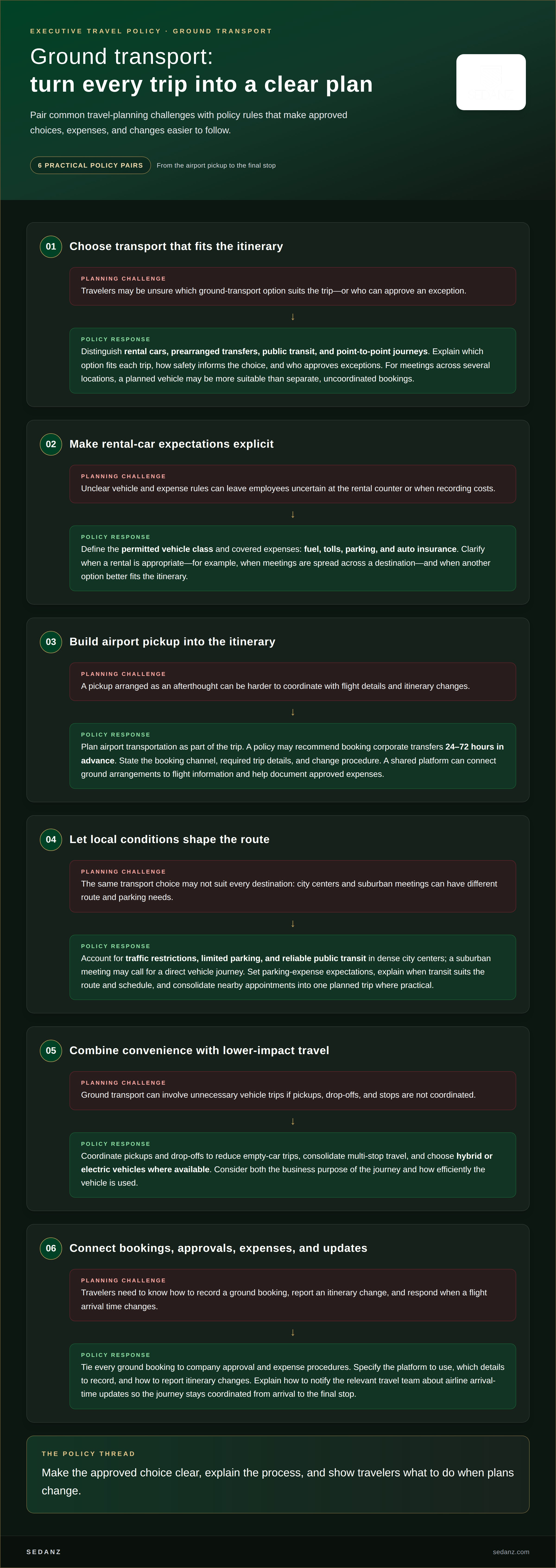
Ground transport rules should make the approved choice clear before an executive leaves the airport. A corporate policy can distinguish rental cars, prearranged transfers, public transit, and point-to-point journeys. Explain which option fits each trip, who approves exceptions, and how traveler safety informs the decision. For example, a day of meetings across several locations may call for a planned vehicle rather than separate, uncoordinated bookings.
For rental cars, define the permitted vehicle class and covered expenses. Explain how employees should handle fuel, tolls, parking, and auto insurance. Clear instructions help travelers submit consistent expense records and avoid uncertainty at the counter or after a journey. Specify when a rental is appropriate, such as when meetings are spread across a destination, and when another transport option better suits the itinerary.
Plan airport transportation as part of the itinerary, not as an afterthought. A policy may recommend booking corporate airport transfers 24-72 hours in advance, giving the travel team time to coordinate the pickup. Include the booking channel, required trip details, and the procedure for changes. A shared platform can keep ground arrangements connected to flight information and make approved expenses easier to document.
Let local conditions shape the plan. A dense city center may have traffic restrictions, limited parking, or reliable public transit, while a suburban meeting may require a direct vehicle journey. Set expectations for parking expenses and explain when transit suits the route and schedule. For a day with several stops, consolidate nearby appointments into one planned trip where practical instead of arranging separate journeys.
Sustainability can complement convenience and traveler safety. Reduce empty-car trips by coordinating pickups and drop-offs, consolidate multi-stop travel, and choose hybrid or electric vehicles where available. For organizations provisioning executive vehicles, working with fleet leasing specialists such as Fleetsauce can help businesses source premium hybrid models that meet corporate duty-of-care and sustainability goals. These steps help travel teams put lower-impact ground transport into practice without overlooking route demands. A useful policy considers both the business purpose of a journey and how efficiently the vehicle is used.
Connect every ground booking to the company’s approval and expense procedures. Tell travelers which platform to use, what details to record, and how to report an itinerary change. Because airlines may update arrival times, explain how travelers should notify the relevant travel team about delays. Clear rules support consistent booking management and give executives a straightforward plan from arrival to their final stop.
2. Preferred suppliers and vetted safety standards
A preferred-supplier program gives employees a clear route to book business travel consistently. Companies can review their 5-10 most-used carriers by booking volume and revenue, then direct travelers toward approved suppliers. The program can also identify which providers meet company-approved cleaning and safety standards. Clear criteria help travelers understand why an approved option may take priority over a cheaper or more convenient alternative.
Duty of care means a company’s responsibility for employees’ safety, security, and well-being during work travel. For an executive itinerary, that includes considering the supplier, destination, journey timing, and traveler’s circumstances. A travel program can set safety requirements for ground transport and other suppliers, then show employees where to find guidance. Duty-of-care systems can also help organizations manage relevant information and communications.
Hotel rules should explain how employees choose approved properties and what spending limits apply. Set destination-sensitive caps that account for seasonality, traveler safety, and local availability; one global limit may not suit every itinerary. Specify whether standard rooms are the default and which incidentals qualify for reimbursement. For example, require approved booking channels while allowing a documented exception when suitable lodging is unavailable within the applicable cap.
Approval workflows should name the required approver, the information submitted, and the route for exceptions. A travel request can include destination, dates, business purpose, and estimated airfare and ground-transport expenses. Require pre-trip approval, then route exceptions to an authorized manager or finance lead with a written reason. A sample policy may require direct CFO or executive approval for an exception fare above $5,000.
For international business travel, assign responsibility for reviewing destination advisories and determining whether the specific itinerary requires entry documents, including visas. Include that review in pre-trip approval and give travelers a clear place to find current safety and health advisories. Since requirements depend on the destination and traveler’s circumstances, identify the process and responsible team rather than assuming one rule applies everywhere.
Executives should prepare for cybersecurity risks when handling business information away from the office. Cover device security, account access, and the handling of confidential documents during travel. For example, employees should know how to report a lost device and where to get internal support. Keep instructions concise, accessible before departure, and consistent across the travel program.
Pairing approved suppliers with clear escalation steps turns safety expectations into usable procedures. For scheduled executive journeys, planned point-to-point transportation can be part of the company’s approved travel arrangements.
3. Airfare classes, flexibility, and included amenities
Set a clear cabin standard before booking begins. Economy is the usual choice for domestic and short-haul business travel. A policy can permit premium economy or business class for long-haul journeys, overnight flights, medical needs, executive travel, or customer-funded trips. Define who approves each exception and what information the traveler must submit. This gives finance a consistent basis for reporting and helps employees understand what compliance requires.
Use route data to shape cabin rules rather than applying one threshold everywhere. Reviewing 12-24 months of fare data can reveal typical differences between economy and premium cabins. A policy may allow business class when its fare is no more than 35% above flexible economy. On a premium-friendly route, a different sample threshold might allow a premium cabin up to 40% above flexible economy.
Trip duration and business purpose also matter. A policy could permit business class on a 10-hour flight to London when its fare is within 25% of premium economy. For individual contributors or engineers, premium cabins may be limited to very long flights, with over 12 hours as one example threshold. Tie exceptions to the itinerary and meeting obligations, not job titles alone.
Give flexible bookings their own rule. Specify when travelers may choose refundable fares or flexible cancellation terms, especially when meeting dates or client plans may change. Explain how employees should use unused airline credits and who records them for future travel. This avoids treating the lowest initial fare as the only measure of value when a schedule change could disrupt a conference or client meeting.
Define which airfare amenities the company covers. Name items such as checked luggage, meals, and in-flight entertainment, and explain how employees document eligible expenses. Clear rules help travelers distinguish fare benefits from separate purchases. Connect airfare policy to ground arrangements too: a changed flight may require transport updates, so the booking process should capture itinerary changes.
Make the approval path practical. State which cabin classes employees may book, when manager approval is needed, and how exceptions are recorded. For example, a short domestic trip may stay in economy, while an overnight international flight may qualify for a different cabin under defined conditions. Review these rules alongside airfare reporting so the travel program can adjust thresholds as route patterns and business needs evolve.
4. Communicating policy changes with travelers
A corporate travel policy works only when employees understand its current rules. Communicate changes before they take effect, explaining what changed, when it applies, and where travelers can find updated guidance. For example, if international bookings require a new approval step, state which trips it covers and who reviews requests. Clear notice lets travelers and travel managers prepare before plans are underway.
Pair the full policy with a brief change summary. Highlight affected areas such as booking, expenses, safety communications, or support instructions. If a traveler’s flight changes, they need to know whether the revised itinerary requires new approval or ground-transport updates. Keep the current version on the company’s established travel platform and remove outdated copies from internal reference points.
Make guidance useful when employees need it. Share policy information through the channels travelers already use for booking and pre-trip details. For a significant change, pair the announcement with a short example, such as how to submit an exception request or report a new itinerary. Travel managers can point employees to the relevant instructions instead of leaving them to interpret broad policy language on their own.
Companies can compare travel management platforms by assessing how each supports booking rules, approval workflows, safety communications, expense documentation, and exception reporting. Measure policy compliance through approved-platform bookings, out-of-platform activity, exception patterns, delays, itinerary inefficiencies, and traveler feedback. Apply executive travel policy best practices 2026 by selecting measures that reveal whether travelers can follow the revised process.
Track whether the change is working, not just whether it was announced. Review exception rates by department; a rate above 15% of bookings may indicate a need for manager intervention or policy review. Examine booking records alongside traveler feedback on comfort, timing, and transport. Assess whether executive travel policy best practices 2026 are working by looking for recurring confusion and missed steps. Clarify instructions or adjust workflows when patterns emerge.
Review the policy at least once a year, and revisit it when travel volume, risk exposure, finance processes, or company structure changes. Before revising the rules, identify the traveler groups and trip types affected. For instance, a new approval requirement for high-risk destinations needs clear instructions for the traveler, approver, and support team. Planning these details in advance keeps risk management practical.
End each announcement with a specific next step: read the revised guideline, update an upcoming trip, or use the new approval route. Explain where employees can raise questions and how to report a travel issue. When changes arrive before the next flight or conference booking, employees can act with clearer expectations and fewer avoidable surprises.
5. What should an executive travel policy include in 2026?
A useful executive travel policy brings booking, approvals, safety, and expenses together in one clear framework. Direct employees to an approved travel platform or travel team for business bookings. Define which trips need pre-trip approval, who grants it, and how travelers request exceptions. For example, a proposed trip to a high-risk destination can go through a separate review before reservations are made.
Set booking guidance for airfare, hotels, and ground transport without imposing one rule on every itinerary. Explain permitted cabin classes and hotel standards, and how destination, seasonality, traveler safety, and availability shape hotel caps. State which booking channels employees should use and restrict off-platform reservations, which can reduce visibility into spending and traveler location.
Make safety instructions practical. Tell travelers how to keep itinerary details current, follow destination guidance, and respond to safety communications. Explain whom to contact during a travel issue, what to do if illness occurs, and where to find current destination health and safety advisories. For international trips, include a pre-departure process for reviewing travel documents and relevant destination information.
Make payment and expense rules equally specific. Name approved company payment methods and define when using a personal card is an exception. Explain which records finance requires, such as receipts, booking confirmations, invoices, and business-purpose details. State expense-report deadlines and expected reimbursement processing times. U.S. companies may base meal, gratuity, and incidental allowances on GSA per diem guidelines for U.S. cities and states, and U.S. Department of State guidelines for foreign countries.
- Booking: State the required platform, approval workflow, air and hotel guidelines, and exception process.
- Safety: Provide trip-update expectations, destination guidance, and support instructions.
- Payment: Identify approved payment methods and required expense documentation.
For C-suite travel, set clear spending controls and approval responsibilities, keeping each rule easy to follow. Capture booking and expense data so the company can assess exceptions, delays, itinerary inefficiencies, and traveler feedback. Review the policy at least once a year, and when travel volume, risk exposure, finance processes, or company structure changes. Regular review helps keep written guidance aligned with actual business travel needs.
Sedanz
Sedanz supports executive travel plans with chauffeured transportation arranged around the itinerary. When a policy calls for coordinated ground travel, Airport Transfers, Point-to-Point Transfers, and Hourly Charters can organize journeys between airports, meetings, and events. Luxury Sedan Service provides an executive travel option for individual itineraries. These services can fit a company’s approved booking process and give travel teams a defined transportation arrangement to include in trip planning.
Consider Sedanz when an executive itinerary needs scheduled ground transportation, whether for an airport arrival, multiple appointments, or a special event. Sharing clear trip details helps align the arrangement with the traveler’s plans and company procedures.
For executive ground transportation, contact Sedanz to discuss your itinerary.
Make safer travel part of the way your company works
A policy is more useful when employees can apply it without slowing decisions or relying on informal guidance. Give each travel manager clear responsibility for communicating updates, collecting feedback, and bringing recurring issues to the right decision-makers. This creates a steady process for refining the traveler experience as business needs change.
Put executive travel policy best practices for 2026 into practice by treating the policy as a working framework, not a document that sits untouched after approval. Invite travelers to flag unclear instructions after a trip, then use those observations to improve the next version. A thoughtful review can help preserve a consistent standard while allowing the policy to adapt to changing itineraries and priorities.
For support with planned executive ground transportation, contact Sedanz about executive travel. A considered next step can help your team put its travel approach into motion with greater confidence.
Frequently Asked Questions
What is Duty of Care in corporate travel?
Duty of care means an employer takes responsibility for employees’ safety, security, and well-being during work trips. In practice, it shapes decisions before and during travel. For example, a company can give travelers a clear way to report an itinerary change, find destination guidance, or contact internal support. Make these steps easy to locate so executives know what to do when plans or circumstances change.
How can companies reduce stress during business travel?
Reduce uncertainty with one clear itinerary and a straightforward process for handling changes. Before departure, provide meeting details, booking confirmations, ground-transport arrangements, approval records, and the right internal support contact. For a trip with several appointments, organize the schedule in sequence and allow for local traffic or delays. If a flight changes, explain how to update connected arrangements. Clear, accessible instructions help executives focus on the purpose of the trip.
How far in advance should corporate transportation be booked?
Book corporate airport transfers 24-72 hours in advance, as recommended in the article’s ground-transport guidance. That window gives the travel team time to coordinate a pickup and connect it with the itinerary. For a conference or special event, transportation is recommended 1-2 weeks ahead, when advance planning can help manage multiple movements. Include arrival details, destination, and any planned stops in the booking request, then update the arrangements if flight times change.
What are the most important business travel best practices in 2026?
Use an approved booking channel, define who authorizes trips, and make safety and expense procedures easy to follow. A practical policy also explains how travelers handle itinerary changes, exceptions, required documentation, and support during a trip. Review the rules at least once a year, or sooner when travel volume, risk exposure, finance processes, or company structure changes. For executives, clear decision rights support consistent oversight without leaving travelers uncertain about what to do next.
What are best practices for executive airfare booking, cabin class, and upgrades?
Set cabin eligibility according to journey length, business purpose, and approval needs rather than treating upgrades as automatic. Economy is standard for most domestic and short-haul business travel; a policy can define when premium economy or business class is permitted. Before booking, compare fare flexibility and covered amenities, including luggage or meals. Record approved exceptions and unused airline credits through the company’s process so later reporting reflects both the fare choice and its business rationale.
What duty-of-care and traveler safety requirements apply to executive business travel?
Set safety procedures to fit destinations and travel operations instead of relying on one generic instruction. Tell executives how to access current destination guidance, keep trip details updated, respond to safety communications, and report an issue. Include a process for illness during travel and identify internal support contacts. For a higher-risk itinerary, require an approval review before booking and make the decision path clear to both traveler and approver.
What expense documentation, reimbursement, and receipt rules should executives follow?
Follow the company’s finance process for payment, receipts, and expense submission. Keep required receipts, booking confirmations, invoices, and business-purpose details, and use approved company payment methods where possible. State the expense-report deadline and expected reimbursement processing time. For example, record the purpose of a client meeting alongside related travel costs so finance can understand the business context. Submit documentation promptly and use the stated exception process if a required record is unavailable.
How should executive travel policies address sustainability and carbon emissions?
Include practical choices that reduce unnecessary vehicle use without compromising trip needs. Encourage travelers to combine nearby appointments into one journey, avoid empty-car trips, and choose hybrid or electric vehicles where available. For example, coordinate meetings by location before arranging ground transport. Companies can also review itinerary efficiency as part of travel-program assessments. Explain how travelers or travel managers should record relevant choices so sustainability is part of planning, not an afterthought.